Buyer's guide
Taxi software: every part, and which ones you need
"Taxi software" is searched for by owner-drivers who want a meter on their phone and by fleets replacing a twenty-year-old dispatch system, and they are not looking for the same thing. This page maps the whole category by who uses each part (the office, the driver, the passenger, the owner and the regulator), so you can tell which parts you need and which you can leave alone.

In short
The short answer
Taxi software is the set of programs a taxi or private hire company runs its work on: a dispatch console for the office, an app for drivers, ways for passengers to book by phone, website or app, a fare and payments engine, and the records and reports left behind. Most firms now rent it as one cloud service, billed by the month per driver or per vehicle, instead of buying and joining up separate programs.
What does "taxi software" actually cover?
The phrase covers more than one product, which is why two people searching for it can want opposite things. A driver who owns one car may mean a meter on a phone and a way to take card payments. A firm with forty cars means the system the whole operation runs on. It is easier to split the category by who uses each part than by a list of features.
The office uses a dispatch console: jobs are typed in or arrive on their own, and each one is given to a car. Drivers use an app that carries the job, the route and the fare. Passengers book by phone, on a website or in an app. The owner needs the money side: fares, card payments, what each driver is owed, invoices for account customers. And the licensing authority, sooner or later, asks for records. One product can cover all five, or a firm can run three or four separate ones that do not talk to each other, which is where most of the daily friction comes from. Each part is taken in turn below, with a link to the page that goes further.
The office: taking the job and giving it to a car
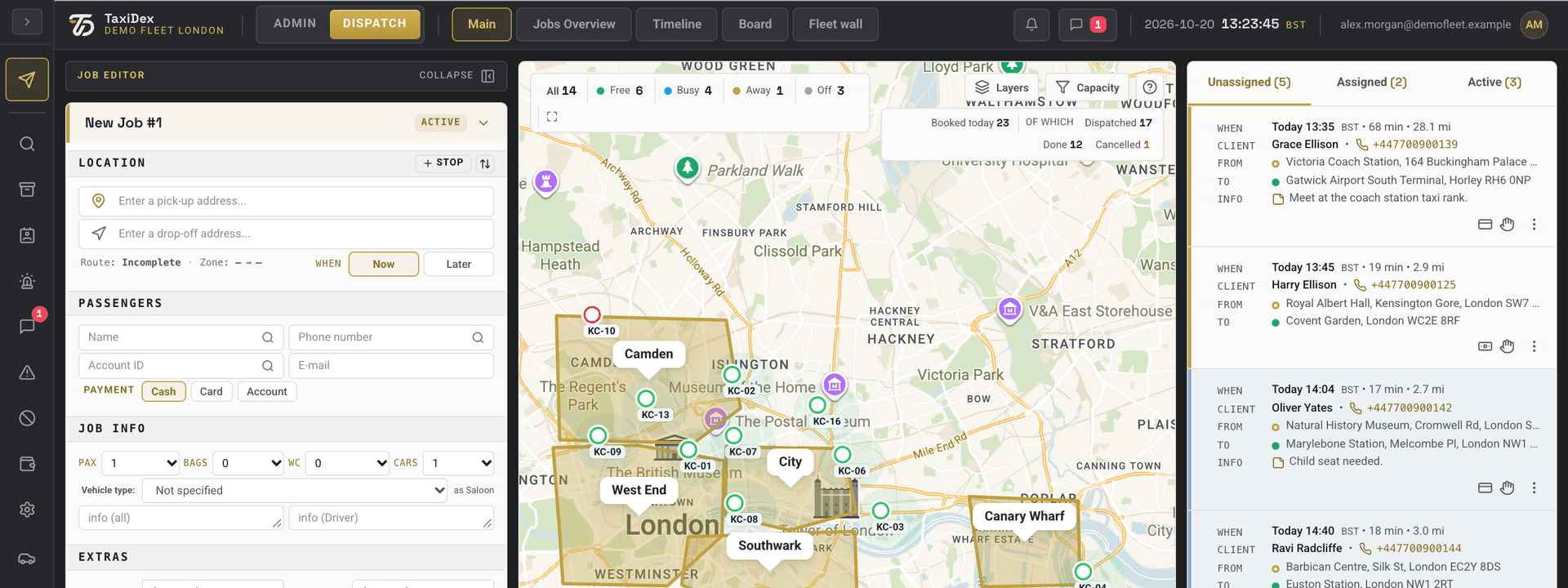
This is the part most people picture, and the part vendors like to demonstrate. A controller types a booking, or it arrives from the app, the website or the phone menu; the system prices it and offers it to a driver, by nearest car, by queue, or by rules you set. A live map shows where every car is, and a queue shows what has not been covered yet.
What matters day to day is less the map than what happens when things go wrong: nobody accepts a job, a driver goes quiet, a pre-booked pickup is ten minutes away with no car on it. Ask to see those moments, not the tidy ones. The two halves of the office side have guides of their own: how a job gets in and how a dispatch system decides who gets it. What the TaxiDex console looks like is on the dispatch software page.
The driver: where the software is really judged
A driver spends a whole shift in the app; a controller spends a minute or two on each job. If the app is slow to show an offer, loses the job in a tunnel or hides the fare, drivers find ways round it, and the office's picture of the fleet stops being true.
The basics are the same everywhere: an offer the driver can accept or decline, the pickup and the drop-off, a hand-over to the navigation app they already use, a meter that follows your tariff, and a receipt at the end. Behind that sit the shift, the documents and the money they are owed. Two things are worth testing on a real phone before you buy: what the app does on a weak signal, and whether an offer still reaches the driver when the screen is off.
Most firms no longer put a terminal in the car; the driver's own phone does the work. Where your licensing authority requires a sealed meter in the vehicle, that meter still sets the legal fare and the app works beside it. More on the driver app and the taxi meter app.
The passenger: phone, website and app
Passengers do not think about software at all. They notice whether booking was easy and whether the car came. Most firms need three doors. The phone has not gone away: a caller should reach either a person who can see their history or, for regulars, a menu that books their usual pickup with one key. A booking form on your own website catches the people who search for a taxi and will not ring. An app suits customers who ride often: they see the price before they book and watch the car approach.
Whichever door is used, the job should land in the same queue, be priced by the same tariff and leave the same record. If your website form sends an email that someone retypes, you do not have a web booker, you have a contact form. Check whose name is on the app, too: some vendors put your bookings in a marketplace app of their own, which in time makes your customers theirs. More on the passenger app, the web booker and IVR phone booking.
The money: fares, card payments and what each driver is owed
The fare is where trust is won or lost, with passengers and with drivers. Software should work the price out from your tariff (distance and time, zones, fixed routes, extras, a different rate at night) the same way on every channel, and be able to show how it got there. A price a controller can type over without a trace is a dispute waiting to happen.
Then the money has to be divided. Card payments arrive through a payment provider, cash stays with the driver, account work is invoiced at the end of the month. From the completed jobs the system should produce what each driver is owed, or owes, on the arrangement you actually have with them: a commission on each fare, a flat fee per job, a weekly rent for the car. Firms that do this in a spreadsheet do it twice, once to work it out and once to explain it. Finally the figures have to leave the system in a form your accountant accepts. More on fares and tariffs, driver settlements and taxi accounting software.
The paperwork: records, expiry dates and inspections
Taxi and private hire work is licensed, and a licence comes with duties to keep records. The details differ by country and by council, so the first rule is to read your own conditions. In practice an authority can ask who booked a journey, when, from where to where, which driver and which vehicle did it, and whether both were licensed on that day.
Software earns its place here in two ways. It keeps the record without anyone having to remember to, and it holds the expiry date of every driver licence, badge, insurance policy and vehicle test, warning the office before one lapses instead of after. Ask how far back the records go, whether a changed booking shows who changed it, and how quickly you could hand a month of journeys to an officer standing at the counter. For UK private hire the duties are set out in the private hire software guide; the fleet side is on the taxi fleet management software page.
Which parts does a firm of your size need?
One car, working alone: you may not need a dispatch system at all. A meter, a way to take cards and somewhere to keep receipts cover it, and a console nobody sits at is money wasted. TaxiDex has a monthly minimum that a single car will not earn back, so it is the wrong choice here.
Two to ten cars: the moment a second person shares the work you need one place where jobs are written down and one way to hand them out. A cloud console and a driver app do that, and the phone is usually still the main door.
Ten to fifty cars: this is where the rest starts to pay for itself. A passenger app and a web booker take pressure off the phones, account customers want invoices, and driver settlements stop fitting in a spreadsheet.
Above fifty: rules begin to matter more than people. Zones, vehicle classes, pre-booked work stacked days ahead, several controllers on shift, and other systems that need your data. At this size ask hardest about what happens when things go wrong and about getting your data out. Limousine and chauffeur fleets have needs of their own, covered in the chauffeur software guide.
How is taxi software sold?
Almost all of it is now rented by the month and runs in a browser, with nothing installed in the office. The bill is counted in one of four ways: per driver, per vehicle, per trip, or as a share of your fares. The unit matters more than the headline rate, because it decides what happens to the bill in a quiet month, when a car is off the road, or when the business grows.
Ask every vendor for the same four things in writing: the monthly rate, the smallest bill you can receive, anything charged once at the start, and what it takes to leave with your data. TaxiDex charges per active driver per month and publishes both the rates and the minimum on its pricing page. For the wider market, platform by platform, see the guide to taxi dispatch system prices.
Shortlisting
What to require of any vendor — including us
Free guide
Score them all on the same scale
The buyer's guide turns this into a requirements worksheet and a weighted scorecard. Vendor-neutral, so it works just as well for shortlisting someone other than us.
What is taxi software?
The programs a taxi or private hire company runs its work on: a dispatch console for the office, an app for drivers, booking by phone, website and app for passengers, a fare and payments engine, and the records left behind. It is usually rented as one cloud service.
Is taxi software the same as taxi dispatch software?
Dispatch is the core of it, the part that takes a job and gives it to a car. Taxi software is the wider term: it also covers the driver app, the ways passengers book, fares and payments, driver settlements and the records a licensing authority can ask for. For a single owner-driver it may mean no more than a meter app.
What is taxi management software, or taxi office software?
Two more names for the same thing, seen from the office. Both usually mean the dispatch console together with the parts around it: drivers and vehicles with their documents, shifts, fares, settlements and reports.
Do drivers need special equipment in the car?
Usually not. In most current systems the driver's own phone carries the job, the route and the meter. Where a licensing authority requires a sealed meter in the vehicle, that meter still sets the legal fare.
How much does taxi software cost?
It is normally billed monthly per driver, per vehicle, per trip or as a share of fares, and the smallest monthly bill and any one-off charge matter as much as the rate. TaxiDex publishes its prices: from £7 ($9) per active driver a month, with a £79 ($100) monthly minimum.
Is there free taxi software?
There are free trials, free tiers, open-source projects and apps paid for by a commission on your fares. Each is paid for in a different way: with a time limit, with a cap on cars or trips, with your own technical work, or with a share of every fare.
Does a one-car business need a dispatch system?
Often not. A meter, a card reader and a tidy record of receipts can be enough for one driver working alone. A dispatch system starts to earn its cost when more than one person shares the work and jobs have to be handed from one to another.
Related
Keep reading
- What it costs: per-driver pricing, published in full.
- Already on another platform? The honest map of alternatives, platform by platform.
- Switching: the published 14-day migration protocol and what your fleet owns when it leaves.
See it on your own fleet
Bring your booking mix, your driver count and your current platform. We will walk the parts that matter to you — and say so if we are the wrong fit.