
Meet Dex
Dex — the AI dispatch co-pilot that runs your fleet by conversation
Dex lives inside your TaxiDex console. Ask it anything about your bookings, drivers and revenue in plain English — and let it draft messages, create bookings and dispatch drivers for you. One chat, your whole operation, with you approving every move.
What AI taxi dispatch software actually does
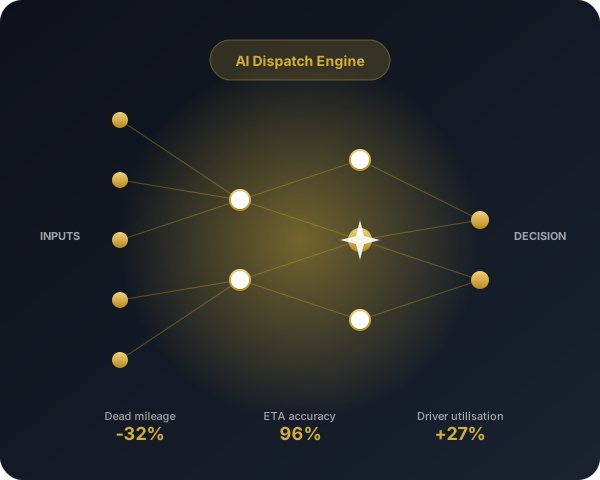
AI taxi dispatch software is dispatch software that decides which driver gets a job without a human choosing. TaxiDex scores every available driver against the booking — distance to pickup, historical acceptance rate, vehicle class, rating, and any rules you set — then offers the job to the best match and moves on if they do not accept inside your offer window.
The scoring is deliberately visible rather than a black box. Each factor is shown with its own weight, so when a dispatcher asks why car 12 got a job instead of car 4, the answer is on screen. Operators do not trust decisions they cannot audit, and neither should you.
Beyond assignment, the same layer forecasts demand by zone for the hour ahead so you can move cars before the calls arrive, and flags dead mileage — the miles driven empty, which is pure cost. Dex, the in-console assistant, answers plain-English questions about your own data ("which driver cancelled most this week?") instead of making you build a report.
Solid day: 312 trips, £4,180 revenue, 97% on-time. Airport work up 18%.
Amir K · Toyota Camry · 3 min out — matched in 184 ms.
Plain English
Ask anything — no filters, no reports to build
Live data
Answers from your real fleet, never stale exports
One chat
Bookings, drivers, messaging & dispatch in one place
You approve
Dex previews every action — nothing happens without a tap
What Dex can do
One co-pilot, your whole operation
Dex is not a chatbot bolted on the side. It reads your live data, answers in plain English, and takes the routine actions your team does dozens of times a day — always with your confirmation.
Ask your data
“How many drivers are free right now?” “What was yesterday’s revenue?” “Who’s my top driver this week?” Ask in plain English and Dex reads your live database and answers in seconds — with rich cards and charts, never a made-up number.
- Natural-language questions across bookings, drivers, revenue and zones
- Live-data cards — e.g. available drivers with phone, vehicle and status
- Trend charts drawn from your own history, not a canned template
Daily briefing
One tap gives you Dex’s morning read on the business: the numbers that matter and what needs attention today — written like a sharp ops manager, not a spreadsheet.
- Yesterday vs today: bookings, completed trips, revenue, cancellations
- Flags what needs action — pending rides, high cancellations, idle fleet
- Drivers online and fleet utilisation at a glance
Demand forecast
Dex learns your booking patterns and tells you where demand is heading and how many drivers to have on — so you staff ahead of the rush instead of chasing it.
- Next-24-hour and 7-day outlook from your own history
- Staffing suggestion for each part of the day
- Busiest hours and busiest zones, called out plainly
Driver report cards
Ask Dex about any driver and get a plain-English performance card — trips, ratings, acceptance, earnings — with the strengths worth rewarding and the habits worth a quiet word.
- Per-driver trips, rating, acceptance rate and earnings
- Strengths and coaching flags summarised in a sentence
- Great for one-to-ones and fair, evidence-based decisions
Smart customer messaging
Tell Dex the situation — “we’re running late,” “driver’s on the way,” “win this customer back” — and it drafts the right, on-brand message. You read it, tweak it, and send with a tap.
- Intent-aware drafts (late, en-route, apology, win-back, promo)
- Edit before it goes — you’re always in control of the words
- Sends over SMS or email; confirm-gated, never automatic
Create a booking by chat
“Book John a car from Heathrow T5 to Mayfair at 6pm.” Dex finds the addresses, picks the right vehicle, quotes the fare and drafts the booking — you confirm and it’s in the queue.
- Turns a plain sentence into a complete, priced booking
- Automatic fare estimate before you commit
- Works even without a paid maps key (OpenStreetMap fallback)
Dex Actions — it acts, not just answers
Dex doesn’t stop at talking. It assigns the nearest free driver, reassigns, cancels, changes status, reschedules, bulk-dispatches your whole pending queue, and clears the driver sign-up approvals — each as a one-tap, you-approve action.
- Suggests the nearest free driver with a one-tap confirm card
- Bulk-dispatch preview then assign-all for a busy queue
- Every action reuses your tested, audited dispatch endpoints — nothing risky is reinvented
Grounded & safe by design
Dex answers only from your real data, shows the numbers behind every reply, and asks before it changes anything. It’s a co-pilot, not an autopilot — your team keeps the controls.
- Real database figures — no hallucinated stats
- Every action is preview → confirm, and lands in the audit log
- Degrades gracefully — your live cards and numbers show even before the AI narration
Explainable dispatch
The Dispatch Brain — and why it writes down its reasons
Normally the closest free driver gets the job, full stop. With the Brain on, the system weighs up everyone who was already eligible and picks the best driver for that job — then records, in plain English, why it chose them.
Distance is the obvious factor and it stays the dominant one. But the closest driver is not always the right one: they may have cancelled two jobs this morning, be twenty minutes from the end of a shift, or already have had four airport runs while someone else has sat empty since eleven. The Brain scores seven of those driver-quality signals alongside distance, and one slider decides how much they are allowed to matter.
Three presets set the whole thing in one tap — Fastest pickup for a busy city centre where a two-minute wait loses the customer, Balanced as the sensible default, and Fair distribution for smaller fleets and rank work where drivers compare their day with each other.
The part operators care about most is the sentence. Every offer stores a plain-English reason and the figures behind it, against the booking. “The system decided” is not something you can say to a driver who has just watched a job go to someone else.
- Distance always dominates — a five-star driver 8 km away never beats a decent driver 500 m away
- It only re-orders drivers your own rules already allowed; it cannot let anyone through
- Same situation, same decision, every time — no randomness, no coin-flip tie-breaks
- Off until you turn it on, and you can replay your own history through it first
And before it touches a single live job, we can run your own booking history through it and show you exactly how often it would have picked someone different. It writes nothing while it does that — no dispatches, no offers, no notifications. If the answer looks wrong for your fleet, you leave it switched off.
What your customers see
AI on the passenger's side of the screen
Five features a customer actually experiences — and not one of them can book a ride, change a price or message anybody. They fill in forms, explain numbers and write one clear line. Your team and your existing rules still do the work.
Customers describe the trip in a sentence
On your booking page a customer types “Heathrow T5 to Reading tomorrow at 6am, two of us with three bags” and the form fills itself in. They still confirm every field and see the price before anything is booked.
- The model never picks the address — it copies their words and your real map lookup still runs
- Anything it is unsure of becomes a question, never a guess
- Impossible dates and absurd passenger counts are rejected in code, not trusted
Tracking links that read like a person wrote them
Instead of “POB”, whoever holds the link reads “Ali is four minutes away in a silver saloon.” Same data your console already has, in words a passenger understands.
- Uses only facts from the booking — it cannot invent an ETA or round one off
- Your existing status chip stays exactly as it is; this is an extra line
- Fewer “where is my taxi?” calls, which is dispatcher time back
Fares that explain themselves
“Your £24.50 covers the 8-mile trip plus the airport pickup fee.” It narrates the breakdown your own pricing produced — it cannot change a price or do arithmetic of its own.
- Every figure comes from your fare rules, not from the model
- Fewer disputes, and fewer refunds given just to end an argument
- Works on quotes and on completed trips
Reviews that sort themselves
A real complaint rises to the top of your queue instead of sitting between two five-star ratings. Your team sees the sorting; the customer never gets an automated reply.
- Topic, sentiment and urgency labelled on arrival
- It labels — it never replies to anyone on your behalf
- An invented category falls back to neutral rather than making one up
Lost property: paste the phone call
Whoever takes the call pastes what the caller said and the log form fills in — item, owner, contact number, and the questions worth asking back. Nothing saves until your operator presses Save.
- Turns a ten-field form during a phone call into one paste
- A “phone number” that is prose rather than digits is discarded
- Logging actually gets done, so items actually get returned
Every one of them is your choice
All five ship switched off, per fleet, and you turn them on individually from Settings → AI. Nothing reaches a customer until you decide it should.
- Per-company switches — your settings never affect another fleet
- None of them can book a ride, change a price or message anybody
- Turn one off and your customers see the ordinary screens again immediately
The design rule throughout is that the model is treated as an unreliable narrator, and everything it produces is re-checked in code. A date of 31 February is dropped and turned into a question rather than quietly rolled forward to 3 March. A booking for “400 passengers” becomes empty rather than being trimmed to 16, because trimming invents an answer and an empty field asks. An address that appears nowhere in what the customer typed causes the whole draft to be thrown away — a pre-filled fake address is worse than a blank one, because someone skimming a filled form will submit it.
None of this is theoretical caution. Each of those rules exists because we found the behaviour it prevents while testing against a live fleet.
On a real shift
Where Dex shows up in your console
Dex opens from the header on any screen — no separate app, no new place to learn. It surfaces answers, cards and actions right where your team already works.

Ask your data
Ask a question, get a grounded answer
Type a question the way you’d ask a colleague — “how many drivers are online, and who’s free to take a job?” — and Dex reads your live fleet and answers in seconds, with a card listing the actual drivers, their vehicles and status. The numbers come straight from your database, so you can act on them, not second-guess them.
Because Dex sits in the header, it’s one keystroke away whether you’re on the live map, the bookings list or a driver’s profile — there’s no separate “AI tab” to go and find.

Dex Actions
It doesn't just answer — it acts, on your say-so
Ask Dex to assign a driver and it finds the nearest free one, shows a confirm card, and books them on a single tap. It can reassign, cancel, change status, reschedule, bulk-dispatch a whole pending queue, and clear the driver sign-up approvals — the repetitive work that eats a controller’s shift.
Every action runs through the exact same tested, audited endpoints the rest of TaxiDex uses — nothing money- or safety-critical is reinvented for the AI — and each one is preview-then-confirm, so Dex never changes anything you didn’t approve.

Insights & messaging
Briefings, forecasts and customer replies — by chat
Tap “Today’s briefing” for Dex’s morning read on the business, ask for the demand forecast to staff ahead of the rush, or pull up any driver’s report card — all without building a single report. When a customer needs an update, Dex drafts the right message and sends it once you’ve read it.
It’s the insight of a full analytics suite and the reach of a messaging tool, delivered the way you already think — in a sentence.
How Dex works
A co-pilot, not a black box
Dex is grounded in your real data, transparent about what it does, and safe by default. Your team always keeps the controls.
- Lives in the header of every console screen — no separate “AI tab” to hunt for
- Reads your live operational data in real time, scoped to your company
- Confirms before any change; each action is written to the audit log
- Runs on Llama 3.3 via Groq with Google Gemini as automatic fallback — bring your own key or use ours
Dex only ever reads your own company’s data, shows the figures behind each reply, and asks before it changes anything — and every change it makes is recorded in the audit log alongside who approved it. The deterministic parts (live cards, KPIs, reports) keep working even without an AI key; only the free-form conversation needs a model. It’s built to make your dispatchers faster, never to take the wheel from them.
FAQ
Questions fleets ask about Dex
What exactly is Dex?
Dex is TaxiDex’s built-in AI dispatch co-pilot. It lives in the header of your console as a chat you can open on any screen. Ask it about your bookings, drivers and revenue, have it draft customer messages, create bookings, and dispatch drivers — all by conversation, in plain English.
Does Dex do things on its own, or just answer questions?
Both — but it never acts without you. Dex answers questions instantly, and for anything that changes your data (assigning a driver, cancelling, messaging a customer, approving a sign-up) it shows a preview and waits for your one-tap confirmation. It’s a co-pilot, not an autopilot.
Do I have to set anything up or learn a new screen?
No. Dex works out of the box on your existing data and sits in the header of screens your team already uses. There’s no dashboard to build and no query language to learn — if you can type a sentence, you can use Dex.
Is my data safe, and can I trust the answers?
Dex only reads your own company’s live data and shows the numbers behind each reply, so answers are grounded, not guessed. Every action Dex takes runs through the same audited endpoints as the rest of the platform and is recorded in the audit log.
What powers Dex, and can I use my own AI key?
Dex runs on Llama 3.3 through Groq, with Google Gemini as an automatic fallback if Groq is unavailable — you never see the switch. You can bring your own key or use ours. Even with no key at all, the deterministic parts (live cards, KPIs, reports) keep working; only the conversational narration needs a model.
How do I know AI dispatch won’t change who gets my jobs for the worse?
Because you can check before you switch it on. We replay your own past bookings through the scoring engine and hand you a report: how often it would have chosen a different driver, and which factor decided it. It writes nothing while it runs — no dispatches, no offers, no notifications. If the answer looks wrong for your fleet, you leave it off.
Why does every dispatch decision come with a written reason?
Because “the system decided” is not an answer you can give a driver. Every offer stores a plain-English sentence explaining why that driver was chosen, plus the numbers behind it, against the booking. When a driver asks why someone else got the airport run, you can show them — and when a complaint reaches you three weeks later, the record is still there.
Can the AI talk to my customers without me knowing?
No. The customer-facing features all ship switched off, per fleet, and none of them can send anything — they fill in a form, narrate a fare, or write one status line on a page the customer is already looking at. Replying to customers stays entirely with your team.
What happens if the AI is down?
Nothing stops. Every feature degrades to the ordinary screen: the booking form works, the tracking page shows its normal status, dispatch runs on your existing rules. There is no state where a booking cannot be taken because the AI is unwell — we test for that specifically.
Does Dex replace my dispatchers?
No — it makes them faster. Dex handles the routine questions and repetitive actions so your controllers spend their time on the exceptions that actually need a human. The final say always stays with your team.
Does AI taxi dispatch software replace my dispatcher?
It replaces the repetitive part — deciding who gets each routine job and chasing drivers who do not answer. Your dispatcher still handles the exceptions that need judgement: the difficult customer, the airport run that has gone wrong, the driver who needs pulling off shift. Most fleets keep the same team and stop hiring the next one.
How does AI driver matching decide who gets a job?
Four weighted factors: proximity to the pickup, the driver's acceptance rate, whether the vehicle class matches what the customer booked, and rating. Each is scored, combined into a single match score, and shown in the console — including the runners-up. You can also add hard rules, so a wheelchair booking can only be offered to a suitable vehicle.
Is AI dispatch worth it for a small fleet?
It matters most when your dispatcher is the bottleneck — which happens well below 20 cars if the phones are busy. The test is simple: if jobs sit unassigned while someone is on another call, automation pays for itself. If you have two cars and a quiet week, it will not.
See Dex run on a real shift
Book a live demo and we’ll show Dex answering, forecasting and dispatching on a fleet like yours — before you commit.